17th August 2021 The Golden Circle.

Borealis docked quietly in Reykjavik around 6 am. It was a misty, drizzly morning, with thick clouds draped over the horizon, hiding any hint of the dramatic mountains we’d seen in brochures. Not exactly the welcome we’d hoped for, but it did lend a certain Nordic mystery to the start of the day. With breakfast stored internally and a packed lunch stashed in a rustling carrier bag, we disembarked by 9 am and climbed aboard the waiting tour bus, our first real taste of Iceland ahead.
Our excursion was the “Golden Circle”, the headline act of Icelandic sightseeing. The brochure gave it an enthusiastic thumbs up for ticking all the “must-see” boxes in the region. Due to COVID-19 restrictions, our 72-seater coach carried just 20 passengers, plus our guide and a driver. It was all very civilised: plenty of room to spread out and no jostling for window seats.
Masks were required throughout the journey, worn diligently by all, except for the driver, who was enjoying a hearty respiratory performance of his own. A gruff cough accompanied every gear change and hairpin bend, delivered with gusto and a good dose of Icelandic phlegm. A little ironic, really, but what can you do?
Our guide, by contrast, was a delight, clearly proud of her heritage, knowledgeable without being too wordy, and possessed of a soothing Scandinavian lilt that made the most mundane fact sound rather charming. Even tales of volcanic eruptions and continental rifts were delivered in dulcet tones, like bedtime stories about lava and tectonic plates.

Our first official stop, excluding the essential loo break around 40 minutes out of Reykjavik, came as a bit of a relief for some, and a mild inconvenience for others. These pit stops are a lifeline if you’re in need, but rather frustrating if you’re not. Still, it provided a chance to stretch legs and observe that the rain had ceased, and there was even a hint of warmth in the air, hopeful signs.
Our route continued across the lava fields of Mosfellsheiði, where the once bare, blackened rockscape had softened under a carpet of moss, coarse grasses and stunted shrubs. It was easy to imagine the ferocity of the eruptions that formed it all, yet now it looked almost gentle, as if time had sanded down nature’s rough edges.
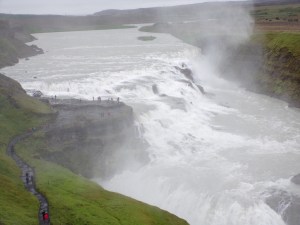
Then came our first ‘proper’ stop, Gullfoss. A name we’d heard and seen countless times in glossy cruise brochures, and here it finally was: Iceland’s most famous waterfall, thundering into a deep canyon with unapologetic force. It lies within Thingvellir National Park, and it certainly earns its reputation. We were greeted by the distant roar long before we reached the viewing platforms. The rain trolls had retreated, perhaps off to menace another coachload, because the clouds parted just enough to throw light onto the falls, catching the spray and offering the briefest hint of a rainbow. Iceland is putting on a show.
The paths and rails were well maintained, and while the air was still cool, it was no longer hostile. We padded along the walkways, taking photos like good tourists and letting the power of the place sink in. It felt wild and a little ancient. Gullfoss doesn’t do anything by halves; it just hurls itself into the gorge with reckless joy.
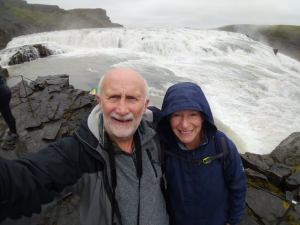
After some time on the coach, we were more than happy to get out and stretch our legs. The journey had taken us quite a distance from Reykjavik, and the promise of nature’s raw beauty was well worth the travel. The Hvítá River, which feeds Gullfoss, drops 30 meters into two powerful falls, and the display of nature’s immense force here was nothing short of breathtaking.
We started with the top two platforms, snapping photos of the falls as they thundered down into the chasm below. The view was magnificent, but it was when we decided to take the narrow cinder path that we really got up close and personal with the falls. The closer we got, the more alive the place seemed. Sheets of mist rose from the churning water, forming a shimmering curtain that soaked us completely as we ventured forward. The mist made the whole experience feel almost ethereal, as if we had stepped into some primordial world.
The final stretch down to the lower platform was a little treacherous, rocky, wet, and steep, but once we made it, the real power of Gullfoss revealed itself in all its glory. The sheer scale of it was awe-inspiring, and the force of the water, crashing and surging, was almost tangible. If you’ve ever stood at Niagara Falls, you know the feeling; the earth beneath your feet hums with the sheer power of nature. Gullfoss stood shoulder to shoulder with Niagara in its might, making it an unforgettable sight.

Returning to the coach, we moved on. The area of Geysir was truly captivating, but we were all excited to see Strokkur, the much more reliable performer in the Haukadalur Valley. Unlike Geysir, which has become a bit of a diva with its unpredictable eruptions, Strokkur erupts at regular intervals, making it a much easier subject for photography. The spout of hot water blasts upwards 30 to 40 meters into the air, a dramatic display of nature’s force.
As Strokkur erupted, I found myself quickly snapping shots from different angles, trying to capture that perfect moment when the geyser hit its peak. The surrounding area was a testament to the geothermal activity, with bubbling mud pools and fumaroles creating a constant haze of steam. It was fascinating to watch the ground so alive with heat and energy, reminding us how much untapped power is hidden beneath the surface.
The air was thick with the smell of sulphur, and the ground felt warm underfoot, adding to the sense of standing right in the middle of a natural wonderland. We all had our cameras out, trying to catch the geyser in action, and I’m sure we walked away with plenty of memorable shots and videos from this dramatic location.

We had our ship-supplied packed lunch just a few more kilometres down the road at a small, pleasant roadside restaurant and bar. I added a pint of Icelandic Gull from the bar to my meal, paid for with my COVID-19-friendly ‘tap and go’ bank card. I’m curious to find out how much that set me back when I return to the UK!

 The next stop was Pingvellir, where the two tectonic plates that formed Iceland millions of years ago meet. Here, the Eurasian plate is gradually moving away from the North American plate at a rate of 3cm per year, creating the Almannagja fault. I had seen this place countless times in TV documentaries and had always wanted to visit, and it far exceeded my expectations. The surrounding area, as seen from any of the viewing platforms, is breathtakingly beautiful. The lake, mountains, and lava fields combine to create a scene that feels straight out of The Lord of the Rings. We walked along the fissure, soaking in the uniqueness of the location, it’s the only place on Earth where you can do this.

Our final stop was a place I had visited before, Perlan. It’s a restaurant and viewing platform in Reykjavik that offers a panoramic view of the city. The experience is much more enjoyable if you can take your time, savour the views, and perhaps have a meal, but since this was part of a tour, that wasn’t possible. While the first visit was worthwhile, this second one didn’t quite have the same impact on me.

We were back on board just after 6 pm. That evening, we decided to dine at one of the specialist restaurants and enjoyed a lovely Goan meal. Afterwards, in the theatre, a highlight of the evening was a superb performance by the ship’s dance crew, with their hilarious take on Freddie Mercury’s skit with the vacuum cleaner. It was uproariously funny, and I’ll remember it for a long, long time.
18th August 2021 Dynjandi Waterfall and back
The ship arrived in Ísafjörður (the capital of the region) by 6:30 am. After a later breakfast than the previous day, we were on the road by 10 am, heading towards Dynjandi (also known as Fjallfoss), a series of waterfalls located in the Westfjords. Today, the Bolearis was anchored near the end of the fjord, surrounded on three sides by towering, craggy, scree-covered mountains, just on the outskirts of this important but rather small settlement.

Our coach first drove through the town, which seemed to be a blend of business premises interspersed with modern, similarly constructed dwellings, with white being the paint of choice for decoration. Reaching the tip of the fjord, we began to climb steeply through verdant grassy meadows, spotting the occasional group of sheep nibbling on the short tufts of grass. The landscape is quite striking, vast and bleak, with the occasional patch of pristine white. The towering, striated mountains rise sharply, coated in dull grey scree, and sliced apart by deep gullies every 100 metres or so. Today, they appeared dry, dark, and boulder-strewn, resembling an alleyway for rocks dislodged from above. In spring, however, they would be rushing with water from the snow-covered heights, tumbling more rocks onto the shores of the fjord and valley. Not a place you’d want to be standing in.

 We drove through two tunnels on the 1.5-hour journey to the falls, both over 5 km long. Like the Norwegians, it seems the Icelanders know how to dig, and they’ve certainly captured my admiration for our Mersey tunnel now seems rather insignificant! Along the way, we skirted several other fjords, passing even smaller settlements than Ísafjörður. We were told that most of the inhabitants of these tiny settlements worked in the metropolis of Ísafjörður. Really?

 Popping out of the last tunnel, we descended steeply to sea level and finally caught sight of the cascade of water known as Dynjandi, spilling over the skyline and plunging 100 metres down the precipice through six further, shorter falls. The Icelandic term dynjandi means thunderous or resounding, and it is a perfect name for this torrent of falling water. Leaving the coach behind, we eagerly set off on foot up the steepening slope towards the thunder. Up to the first platform viewing point, the path was well-constructed, but beyond that, it deteriorated into a slippery and dangerous scramble. I feared not everyone in our group would reach this point.
Making our way to the base of Dynjandi was truly special, the sound, the vibration, the rainbows playing in the mist, and the sheer power of the falling water. But just as remarkable was the view into the fjord, its ring of mountains stretching into the distance, yet never quite reaching the horizon. Icelandic lore is full of giants, and I can certainly understand why.
I lost count of how many photos and videos I took; everywhere you looked, there was a perfect shot. I just hope some of them will do the place justice. On the way up, I stopped briefly to pick a few large, delicious cloudberries, which were growing in abundance just off the path. On the way down, Sue and I swooped on this free natural resource and scoffed handfuls of the purple berries, much to the puzzlement of our fellow travellers. It was their loss; all they had to do was ask, and they too could have shared in this bounty.

 Returning to the coach, we sat waiting to depart with our fellow passengers. Our two very young guides had counted the numbers and realised we were one short. Fifteen minutes past departure time, panic began to set in. Where was the missing Rosemary Blossom? The young man set off towards the waterfall to look for her, while the young woman searched the toilet block and its surroundings, but found nothing. Half an hour passed, and the girl rang the three other coaches to see if the lady had boarded one of them, but apparently not. The coach driver joined the search, and still, no sign of Rosemary.
When the girl returned, we passengers suggested she do another headcount with names, which she did. Yes, Mrs. Blossom had been sitting on the coach alongside her husband the whole time. I think the two young guides will remember their first tour of the season for quite a while!


We arrived back at the ship later than scheduled, but thoughtfully, the restaurant had stayed open for us; it wouldn’t do to break the most sacrosanct rule of cruising: “Feed your cruisers well, and they will be happy.” It certainly worked.
Due to COVID-19 restrictions, we were unfortunately not permitted to leave the ship unless part of an organised tour. Normally, Sue and I would take a stroll into the port during the afternoon and spread a little goodwill and cash among the locals, but it was not to be. Instead, we played bingo on board, and Sue won a full house! The prize was a goody bag of Fred Olsen gifts. We spent the rest of the afternoon on deck, watching the sea life as we sailed away from Ísafjörður.
The evening began delightfully, with warm sunshine and stunning scenery as we emerged from the fjord and headed north along the coast. The ship’s ornithologists had been particularly looking forward to this part of the journey, as we were due to pass beneath the King and Queen Cliffs of Hornstrandir, a remote nature reserve famed for its birdlife and unspoilt beauty. We were set to pass by at 7 pm, with an expert scheduled to provide a running commentary over the PA system.
Sue and I were on deck by 7.15 pm, just in time to see a thick fog roll in, reducing visibility to 50 metres or less, and it didn’t lift for the rest of the evening. Undeterred and with a good sense of humour, the expert from Kent delivered his prepared commentary on what we would have seen. These things happen. We counted ourselves lucky simply to be here, shrugged our shoulders, and headed off for our evening meal, followed by an amusing comedy show from the gentleman from South Yorkshire. The birds of Hornstrandir will have to wait for another time.


Leave a Reply